Introduction
Whenever I engage in a conversation about regenerative issues, and more specifically, about how we need to change the role of consumption in our lives to witness a regenerative future, I’m often confronted with the accusatory question ‘but we live in a consumerist society, so how do you expect us to change’?
By change, I understand that people generally mean something like, ‘consume less, grow my own food, make a tree change or a sea change – move from the city to a coastal town or quiet country town – change my whole way of life etc. The reality of what’s required could involve all of the above, but perhaps the latter comes closest. I suspect if you’ve read my earlier posts, you’ll have a good understanding already about where I’m coming from. If you haven’t read them, that’s OK, there’ll be time later. For now though, just stick with me through this post and I’ll explain in more detail.
Marketing and the promotion of consumption
The often implicit promotion of consumption by marketing, is one of the big challenges that I personally grappled with as I was finding my voice, early in my career as a marketing educator. In the days when marketing was almost exclusively about satisfying customer needs aka wants, and the experienced satisfaction that comes about following consumption, the metric for marketing success, aside from the bottom-line performance of the business, was non-surprisingly, customer satisfaction.
Marketing, satisfaction and non-consumption
Feeling courageous, I recall flipping things around and creating a bit of a ‘he’s not one of us’ moments, when at a marketing conference about 25 years ago I orally presented a paper that carried the title ‘customer satisfaction through non-consumption’.
Anti-marketer!
I was already starting at the time to create a bit of a name for myself as – in their words only – an anti-marketer. Of course, they had it all wrong with their narrowly defined understanding of marketing. My attempts to point this out were mostly to no avail! I would defend my argument and role as a marketing academic, saying that ‘not all consumers are consumers’, or at least not in the Veblen (1899) conspicuous consumption sense, for whom consumption is about flaunting wealth and signalling social status.
In contrast, I would point out that there is a growing interest in society for a more ethical values-driven conscious form of marketing and consumption behaviour. Away from a more is better attitude. Examples include the move toward voluntary simplicity and a burgeoning literature on consumer wellbeing and quality of life. Among others, there is also an emerging interest by many businesses to reduce the negative impacts of their business activity on the environment and on populations affected by extractive exploitative systems1.
Be careful what you listen to!
Needless to say, I didn’t appease everyone, and certainly not one particular senior colleague who many years ago barged into a postgraduate marketing class that I was delivering, advising my students – with cynicism directed at me – to be careful what they listened to! Apparently I was sharing potentially ‘dangerous’ ideas with students. Like those for example that could see students in their post-university marketing careers designing and implementing ethical, values-driven, wellbeing-oriented marketing actions! As you can perhaps imagine, this colleague didn’t gain any brownie points with my students for his abrupt intrusion of our class – the students confided in me as he left the room.
Marketing today
Fast forward to today, and thankfully the marketing academy has witnessed enormous positive change. Now we experience environmental, social and societal issues topping the content of mainstream global marketing conferences, and representing the content of articles published in both dedicated and non-dedicated leading international journals.
Home truth
Its not all roses though, and in spite of the many advances that have been made, we can’t circumvent the fact that we still live today in a predominantly consumer-driven society where a key metric of economic performance is GDP. Remember, this is a measure of how much stuff we consume! And thus, as I wrote in an earlier post, we can also consider GDP a proxy measure of how degenerative we are as a society.
Marketing is the evil of society
While giving an online talk at a planetary health conference in New York in late 2024, in which I strongly argued for the need to change the narrative of marketing, I experienced the usual cynicism aimed at marketing – the one that builds on the notion that…. ‘marketing is the evil of society’!
Consumer role
While incorrect at its core, I suggested that attaching all too easily the label ‘consumer’ to ourselves in our daily lives was partly to blame for this notion. We take on many roles in life: parent, spouse, teacher, sports person and so on. To these we can legitimately add the role of ‘consumer’. Being playfully provocative, I argued that this is a role that we take on all too easily, without giving much conscious thought to the implications of our consumption actions.
Linguistically, usually the verb closely follows the noun. Teachers teach. Parents parent. Swimmers swim. Similarly, if we see ourselves as consumers, what will we do? We’ll consume, because that’s what we do when in that role. Consumers consume. And we’re very good at it too! Consequently, given how powerful language is as a tool guiding behaviour, I suggest we consider the role of language more closely.
Shifting the narrative
Given the importance of language and how it defines role and guides behaviour, I further suggest that we need to shift the narrative and the conversations that we have, not only in respect to what marketing is about, but with greater urgency, who we are as consumers and the roles that we take on vis a vis consumption. We need to ask ourselves why it is that we place such a high importance on consumption – the consumption of finite resources – as a metric for progress?
The possibility of a new role: Co-creator of planetary health
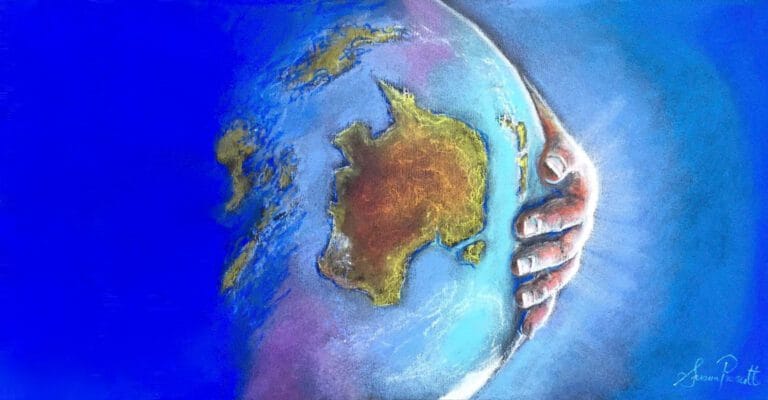
Still at the same conference, and advancing my argument further, I posed the questions: “What would it mean if we were to consider ourselves as co-creators of planetary health rather than as consumers of planetary resources? Would our preoccupation with consumption change?
These questions generated lively chatter among participants. I was being intentionally provocative too, not letting people off the hook with their spontaneous negative banter….’this couldn’t happen’, ‘there’s no way’ etc.
My training in ontological coaching was useful here in enabling me to employ counter arguments with ‘critical thought experiment’ questions such as… ‘what if it were to happen?’ and ‘were it possible, what would it look like’? After a short time, the audience began working together on the task of designing, at least mentally anyway, ‘a new reality’, ‘a new way of being’.
Albeit challenging, it was a positive experience for everyone. In fact, the experience led me to repeat this exercise many times over in subsequent lectures with students. At the same time, it also provided me with a valuable opportunity to learn from others, to see the world through many diverse lenses.
…….Please take a moment now to consider the same questions……
What would it mean if we were to consider ourselves as co-creators of planetary health rather than as consumers of planetary resources?
Would our preoccupation with consumption change?
Go ahead – You have permission to dream big!
Of course, with this post, and the above questions in particular, I’m merely posing at no-risk-to-you, a thought experiment. Dream big here about the kind of a future you wish to see, to co-create, and what your role will be. Will it be that of consumer, or rather co-creator of planetary health?
My take on this question
What’s my take on these questions, you ask? Well, as the originator, it won’t surprise you to hear that, yes, I do think that our preoccupation with consumption would change, although clearly not overnight!
What would it mean and why do I think our preoccupation with consumption would change?
As a starting point, among others……….
- We would follow and be guided by a different set of priorities. We would prioritise the health and wellbeing of the environment, society, communities and relationships.
- We would broaden our understanding about what we need to do for the above to thrive and flourish.
- We would recognise planetary health arising as a consequence of interdependence within and across all systems, and build collaborative partnerships in appropriate response.
- Our knowledge about the detrimental effects of maintaining old beliefs, behaviours and habits would be highlighted, steering us even further away from a degenerative path.
- We would have more like-minded people setting appropriate examples.
- Associated restorative and regenerative behaviours – and attitudes and values upon which they are based – would become normalised in society.
- And the list goes on……………
Conclusion
In this post I have argued that language and narrative play a major role in guiding behaviour. Sometimes language is overt, as is its impact, but at other times it can be covert. In the case of the roles that we take on in society, it’s both.
We can either see ourselves as consumers – treating this as a statement of fact and acting out in this role. Although I should point out, doing so will likely steer us further down a path of consumption, each step further depleting the natural resources upon which we depend for the continuation of a safe and just space for all life on planet Earth.
Alternatively, we can see ourselves as co-creators of planetary health. We can identify and follow a different set of priorities oriented toward the natural environment and the flourishing of all life on planet Earth. Note, these two are mutually interdependent. We can work together in the co-creation of a regenerative future.
In summary, language, behaviour and degeneration, and by implication regeneration, are connected. They go hand in hand. To witness a regenerative future we need among others to change the language and narratives that we use in our conversations about the role of consumption. We need to redesign the conversations that we have in order to co-create the kind of future that we would all like to see emerge. A future that has planetary health front and centre of all major national and international decisions, and sees each of us as active co-creators in that regard.
Next steps
In my next post I explore the obvious questions ‘How do we change the narrative around consumption, what would this look like, and whose responsibility is it anyway?’
References
Veblen, T. (1899). Mr. cummings’s strictures on” The Theory of the Leisure Class”. Journal of Political Economy, 8(1), 106-117.
- For a more comprehensive overview of relevant research in this area, see for example the Journal of Macromarketing for which I am an editorial board member. ↩︎