
Recap and introduction
In my last post I suggested that our behaviours are guided by identified roles and the language that surrounds them. In the same way that teachers teach, as consumers we consume. Furthermore, we take on the role of consumer too fervently without giving our behaviours and their impacts much thought. Unwittingly by implication, we are contributing not only to a degenerative economy, but moreover, to the depletion of planetary health.
Why? Because society normalises the act of consumption and the consumer role. Also, the global economy is dependent on us carrying out this role as diligently as we can. And we’re really good at it too!
I’m reminded here of the importance that has been placed on consumption. This is true at least in the western developed world where national patriotism requires we consume to fuel GDP growth. An example of this following the September 11 Twin Towers attack, is the then US President George Bush’s plea for Americans to go out and spend money, ergo consume, to keep the economy going.
Three required changes
Today, largely due to the process of consumption – from extraction through to either decline or circularisation – we are experiencing many environmental and societal challenges e.g., climate destabilisation, biodiversity collapse, widening inequality, and democratic erosion (Pickett et al., 2026).
As I stated in an earlier post, we are literally consuming our future! To move toward a regenerative flourishing future for all, there are at least three aspects to consumption that need urgent attention:
- First, we need to relinquish our dependency on an infinite-growth-through-consumption economic model. Why? Because that model has been successful, in relative terms only, for a very few people in the short term. If we then extend the time horizon, and consider the potential disastrous implications of continuing to travel the same take-make-break-throw away pathway, we would struggle to argue its success for anyone!
- Second, we need to stop the unconscious normalisation of consumption in society. This calls for the introduction of more conscious, alternative, positively-aligned conversations and behaviours orchestrated to a different tune.
- Third, we need to halt the unquestioning willingness with which we contribute to a degenerative economy by acting in the role of consumer.
Three transformational steps?
I suggest that a point of departure can be reflected by the following three transformational steps:
- To the first, we would move from a degenerative economy reliant on the fallacious possibility of infinite growth, to a regenerative economy that emphasises planetary health and the flourishing of all interconnected systems.
- To the second, rather than have consumption normalised in society, which only contributes further in its current form to a degenerative economy and the associated depletion of planetary health, it is the co-creation of planetary health that needs to be normalised and enabled such that it can drive global regenerative agendas at all levels.
- To the third, rather than subconsciously considering ourselves as consumers, complicit directly or indirectly in the depletion of natural resources, and moreover acting out in this role, we would instead consider ourselves co-creators of planetary health, and with commitment, identify and engage in appropriate regenerative conversations and behaviours.
For the latter, we would be guided by a different role agenda. No longer would we consider how consuming product xyz will contribute to our individual happiness, QOL and wellbeing. Rather, thinking at the collective holistic level, we would question how our consumption behaviour, will contribute to planetary health. A thriving, flourishing natural environment and global society for all.
Thus far I have positioned planetary health as a key objective. I now articulate what is meant by planetary health.
What is planetary health?
While the concept of planetary health is not new, one of the most widely cited and policy-guiding definitions originated in the Report of The Rockefeller Foundation-Lancet Commission on planetary health in 2015, in which planetary health was defined simplistically as:
The health of human civilisations and the natural systems on which they depend (Whitmee et al., 2015).
Expanding on the above definition, it includes:
Achieving the highest attainable standard of health, wellbeing, and equity worldwide through judicious attention to the human systems—political, economic, and social—that shape the future of humanity and the Earth’s natural systems that define the safe environmental limits within which humanity can flourish (Whitmee et al., 2015).
We can see this visually represented as follows:
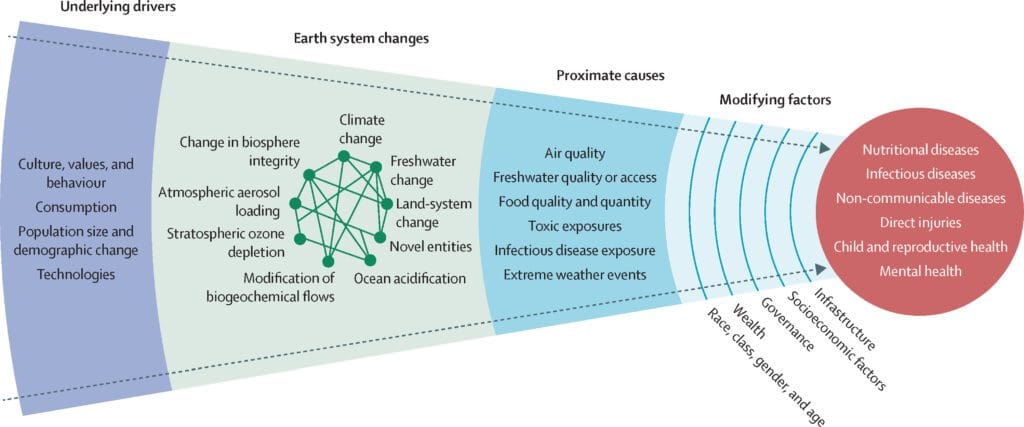
Underlying drivers cause Earth system changes that alter the foundational conditions for human health and wellbeing, leading to adverse health impacts, depending on a range of modifying factors. Earth system changes are represented by the planetary boundaries that regulate the stability, resilience, and life support of Earth (Myers et al., 2025).
Note that the above figure only provides a linear visual representation of factors impacting on health.
Open systems perspective
Appropriately allowing for an open systems understanding of planetary health, we need to recognise the interconnected nature of the elements represented above. Nothing can exist in independence. All phenomena can only exist in relation to and in dependence on other phenomena. This is what it means to be a part of a functioning ecosystem.
In addition, we also need to allow elements not shown in the above figure to emerge. However, we must recognise that it would be difficult to visually offer a complete representation with all potential elements included. Consequently, as our focus shifts, we need to allow limiting borders and interpretations to remain open for expansion.
Consumption in the context of business and the economy
While on the left of the figure we see consumption, we must also consider consumption in the context of business, and business in the context of the wider economy. Thus, there can be no substantive regenerative marketing without regenerative business, and no regenerative business without a regenerative economy. Each exists as a constituent contributory part of a regenerative nested whole. Together, they sit within a wider economic and global system that includes many other current and future forms of organisation and governance. Given the complexity, it is appropriate to view the above model as a starting point for conversation and action only. The responsibility for holistic open-minded interpretation and understanding, and by implication expansion, resides with each of us.
Flourishing as holistic health
From a regenerative point of view, where the goal is the co-creation of a thriving and flourishing network of interconnected systems and their constituent parts, we can read ‘flourishing’ alongside both physical and mental health in the above figure. This is permissible because when we speak of flourishing in respect to human health, by implication we are referring to both physical and mental health dimensions.
Summary
In summary, planetary health considers not only the vital biophysical “planetary boundaries” required to support human and wider systems flourishing, but also the upstream socio-cultural, political, economic and technological ecosystems that support (or undermine) well-being (read flourishing) at all scales (adapted from Prescott, 2024).
Transitioning from a degenerative course reinforced by consumption, to a regenerative future that has at its core the flourishing of all planetary health systems and their constituent parts, requires the urgent transformation of all human-made systems.
Next steps
In Part 2 of this post, I will discuss the three transformational steps mentioned above in greater detail. I’ll break them down first in a reductionist way, but only to explore each in turn. The goal thereafter is to rebuild them such that the ‘whole is greater than the sum of the parts’, and our overall understanding developed. I hope that you will join me.
References
Myers, S. S., Masztalerz, O., Ahdoot, S., Gabrysch, S., Gupta, J., Haines, A., … & Rockström, J. (2025). Connecting planetary boundaries and planetary health: a resilient and stable Earth system is crucial for human health. The Lancet, 406(10501), 315-319.
Pickett, K. E., Costanza, R., De Vogli, R., Kubiszewski, I., McGlade, J., Mortensen, L. F., … & Wilkinson, R. G. (2026). Wellbeing for people and the planet: how to value everyone and everything on a thriving planet beyond 2030. The Lancet Planetary Health.
Prescott, S. L. (2024). Planetary health: A new approach to healing the Anthropocene. Annals of Allergy, Asthma & Immunology, 133(6), 649-657.
Whitmee, S.; Haines, A.; Beyrer, C.; Boltz, F.; Capon, A.G.; de Souza Dias, B.F.; Ezeh, A.; Frumkin, H.; Gong, P.; Head, P.; et al. Safeguarding human health in the Anthropocene epoch: Report of The Rockefeller Foundation-Lancet Commission on planetary health. Lancet 2015, 386, 1973–2028.