Planetary boundaries framework
The planetary boundaries framework introduced in 2009 (1), marks out the safe operating limits for human activity on Earth across nine areas: climate change, biosphere integrity, novel entities (pollution), biogeochemical flows (nutrients), land systems change (land use), freshwater use, ocean acidification, atmospheric aerosol loading and stratospheric ocean depletion.
Seven of nine Earth system boundaries breached
Since its introduction in 2009, significant negative change has already been witnessed, with as of 2025, the first 7 of the above 9 mentioned Earth system areas breached (2).
Earth pushed to its limit
Given that the planetary boundaries depict a safe operating limit for human behaviours, the fact that we have already breached 7 of 9 boundaries, signals that the way that we are currently living has pushed Earth to its limit, and furthermore demonstrates that Earth’s resilience is weakening, as witnessed with accelerating global warming and many ecosystems showing signs of degeneration.
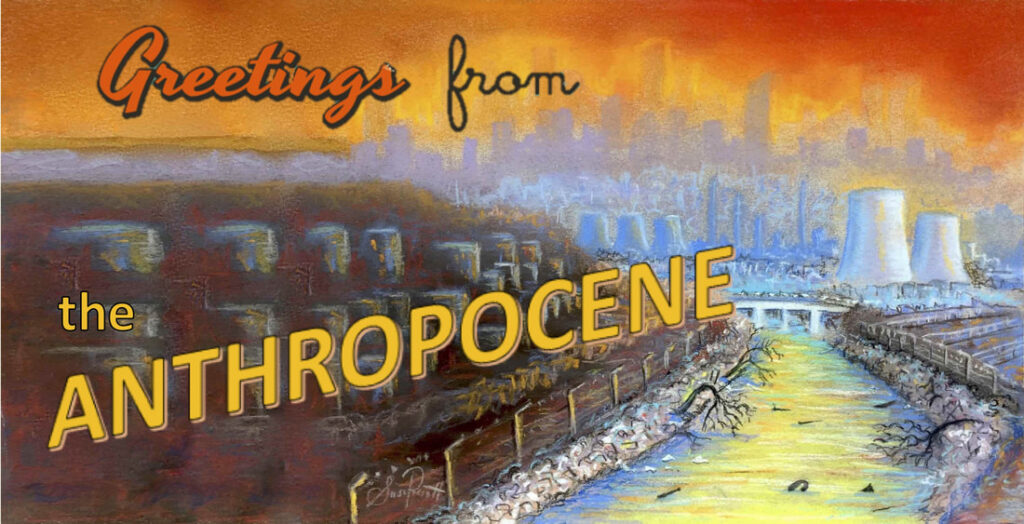
The anthropocene
Researchers at the Stockholm Resilience Centre (SRC) talk of current times in terms of the anthropocene (3), an era where the detrimental impacts on our planet’s systems are identifiably and predominantly a consequence of human activity.
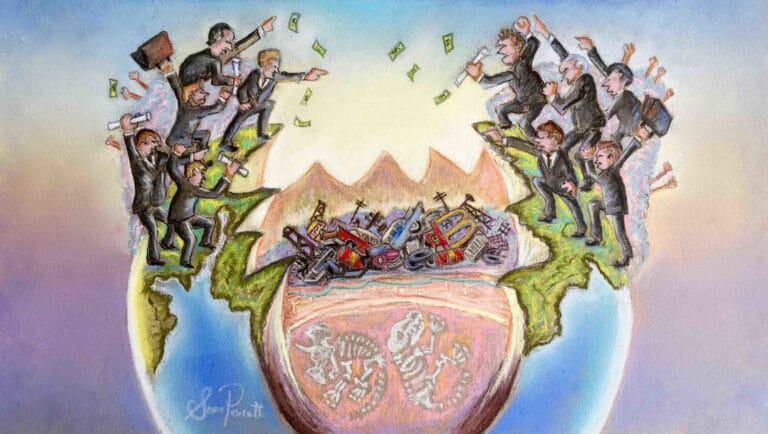
Who is responsible for Earth’s degeneration?
While the culprits are many, clearly an economic system that financially rewards the extraction and degeneration of earth’s finite resources for the purpose of consumption in a marketplace is a central guilty party. Our consumption lifestyles, whether in the businesses we work for, or as individual societal members practicing consumption, in some cases seemingly to the level of worship, denotes that it is our collective responsibility to shift from a preoccupation with degenerative behaviours to those that can be described as regenerative i.e., to those that contribute to a flourishing thriving planet both in environmental as well as societal terms.
The content of all of the posts in this Blog broadly discuss why we need to live more regeneratively and highlight ways that we can do so. I hope that you find the content illuminating, and moreover, that it spurs you into exploring what a regenerative future looks like for you and how you can get there.
References
- Rockström, J., Steffen, W., Noone, K., Persson, Å., Chapin, F. S., Lambin, E. F., … & Foley, J. A. (2009). A safe operating space for humanity. nature, 461(7263), 472-475.
- Planetary Boundaries Science (PBScience). 2025. Planetary Health Check 2025. Potsdam Institute for Climate Impact Research (PIK), Potsdam, Germany. https://www.planetaryhealthcheck.org/wp-content/uploads/PlanetaryHealthCheck2025_ExecutiveSummary.pdf
- Crutzen, P.J. (2006). The “Anthropocene”. In: Ehlers, E., Krafft, T. (eds) Earth System Science in the Anthropocene. Springer, Berlin, Heidelberg. https://doi.org/10.1007/3-540-26590-2_3