Introduction
Having spoken about the specific importance of regenerative business in my lecture classes for a few years leading up to my retirement, it dawned on me, and I don’t mean in any loud revelatory way, but rather with quiet obviousness, that all entities thrive and flourish in their context when the conditions are right for them to do so. Similarly, when the conditions are not right, they are unlikely to thrive and flourish. Logically therefore, the same is true for regenerative businesses. For them to be able to thrive and flourish as regenerative businesses, in a regenerative way, the environments in which they operate similarly need to support regenerative endeavours. Given that businesses operate in the economy, it stands to reason therefore that for regenerative businesses to thrive and flourish, what they need is a supportive regenerative economy in which to do so. Sadly though, to the best of my knowledge, there are no regenerative economies. Perhaps that’s because the global economy itself is degenerative!!
Regenerative economy
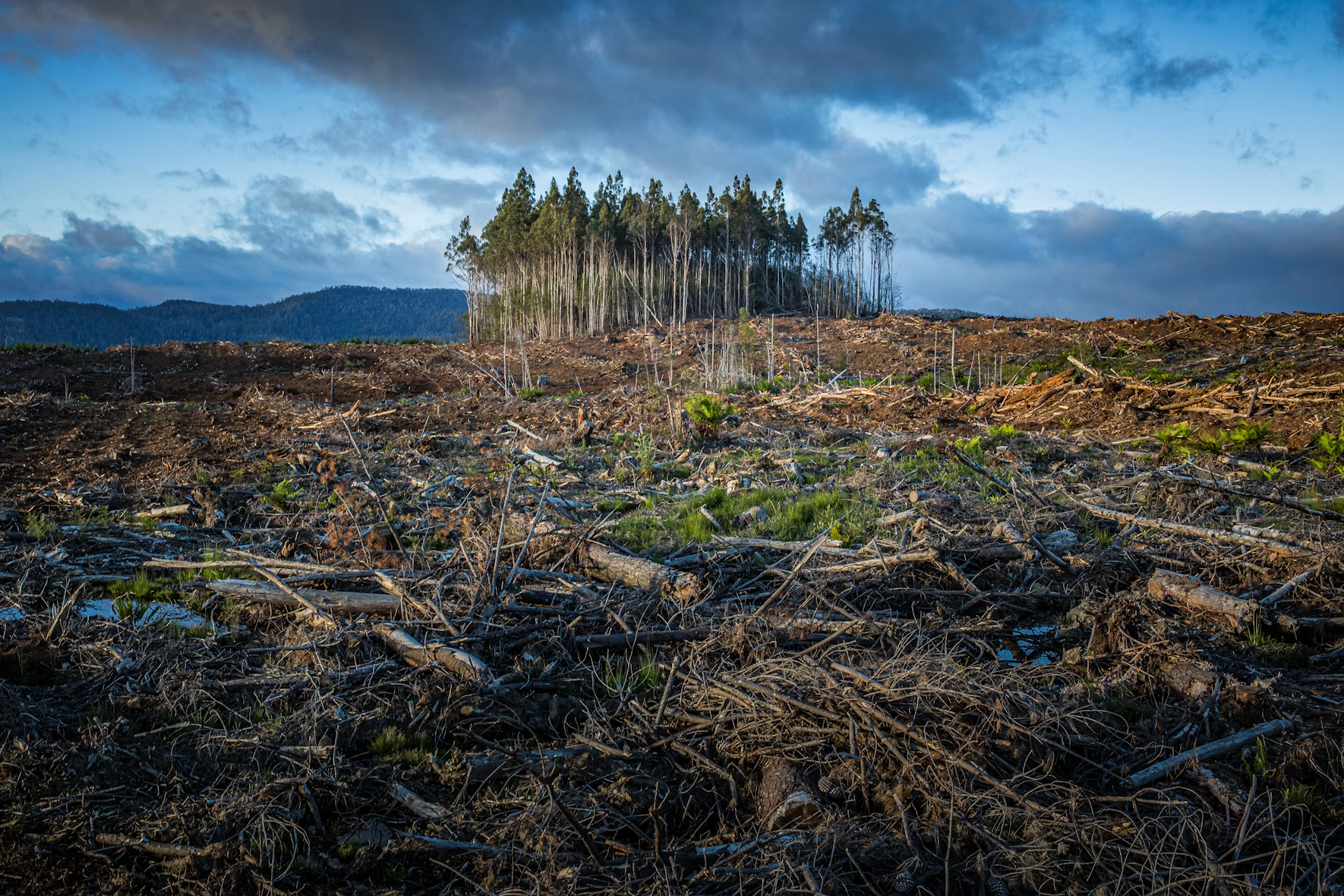
As I’ve mentioned elsewhere in this blog, the current economic environment, the one within which all businesses operate, is one that supports degeneration. Degeneration via the competitive conversion of finite resources into goods and services (products) for exchange in a marketplace, for in most cases, the highest level of financial profit. Competition exists both on the side of production – which is a form of consumption – as well as it does at consumption, where simplistically the goal on both sides is value and utility maximisation. Businesses seek to maximise the value of their return on investment (ROI), as indeed do consumers.
Consequently, with both businesses and consumers seeking to maximise their ROI as well as maximise utility, they do so in a way that by implication devalues the finite resources that serve as an input. Let’s have a closer look at what I mean here by ‘devalues’.
Cost internalisation
To start with, if the actual costs of production and consumption were considered in full, that is, at the true cost level, and they were internalised, the likely result would be less degeneration because cost itself would take on a different meaning for businesses. To clarify, by ‘cost internalisation’, I mean, were all of the external costs of production and consumption, such as those associated with environmental degeneration, pollution and negative health impacts, also considered in the actual price of products, we would have a more authentic representation of the actual cost of products in the economy. Were this the case, I would argue that the economy would likely be less degenerative because the perception of the true value of resources would be more realistic, and consequently, associated behaviours would be less degenerative.
As a note of caution though, when we think about degeneration, it is worth pointing out that the goal, a regenerative economy, is about much more than ‘less degeneration’. Indeed, it is even about more than the absence of degeneration. It is about the presence of regeneration.
Before I close this post, I recognise that I’ve opened a pandoras box here by introducing the economic concept of ‘cost internalisation’. Simplistically, a degenerative economy thrives when the true costs of production are externalised. So, the big question is, who or what bears the brunt when costs are externalised?
What do you think?
Future post
In Part 2, I’ll expand further on the topic of how we can bridge the gap between the absence of degeneration and the presence of regeneration. In Part 3 I will revisit the concept of cost internalisation and its relationship with regeneration.