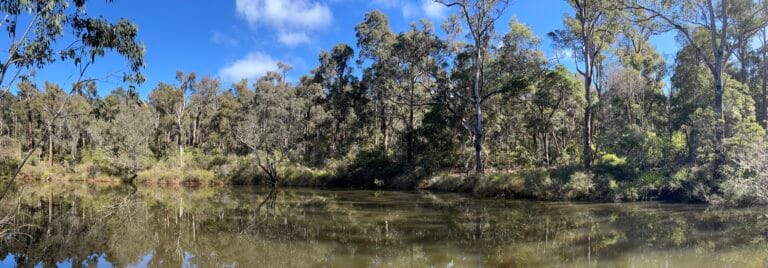
Workman’s pool, Nannup, Western Australia. Image by Dave Webb
Focus of this post
So far in this blog I’ve talked a lot about what’s wrong with our degenerative extractive economic system, and what we need to do to transition toward a regenerative economy, and by implication, a regenerative future.
These discussions have predominantly resided in the ‘work’ domain. To expand our appreciation of what’s involved in co-creating a regenerative future, the next three posts explore what I’ll refer to here, as the ‘living’ domain.
I’ll be discussing the importance of nature to human health and wellbeing. In addition, I’ll be considering the connection between regenerativity and where we live, whether in the country, on the coast, remotely or in a village, town or city. I’ll be considering both the built and non-built environments and what we need to do to ensure that these environments are likewise regenerative.
The living domain
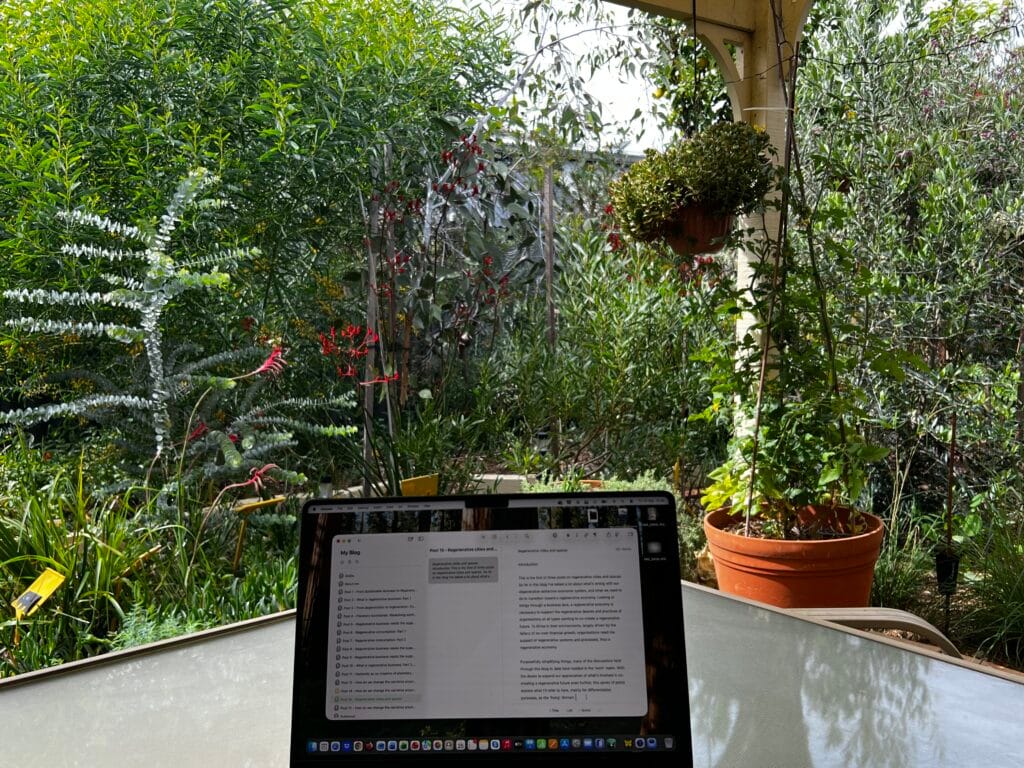
I’m sitting here writing this post in my rear garden, a lush, colourful, dense, productive native green space. It is already thriving and in bloom at this early Spring time of the year in the southern hemisphere. The sun is shining, and a little mid-morning warmth can be felt where I sit.
My garden is teeming with life on multiple levels – below the ground, at ground level and above the ground too. Following studies in permaculture and landscape design, my goal for this small space is to create a rich thriving ecosystem that will attract diversity of life back into the area. All part of a wider regeneration plan.
Attracting diversity
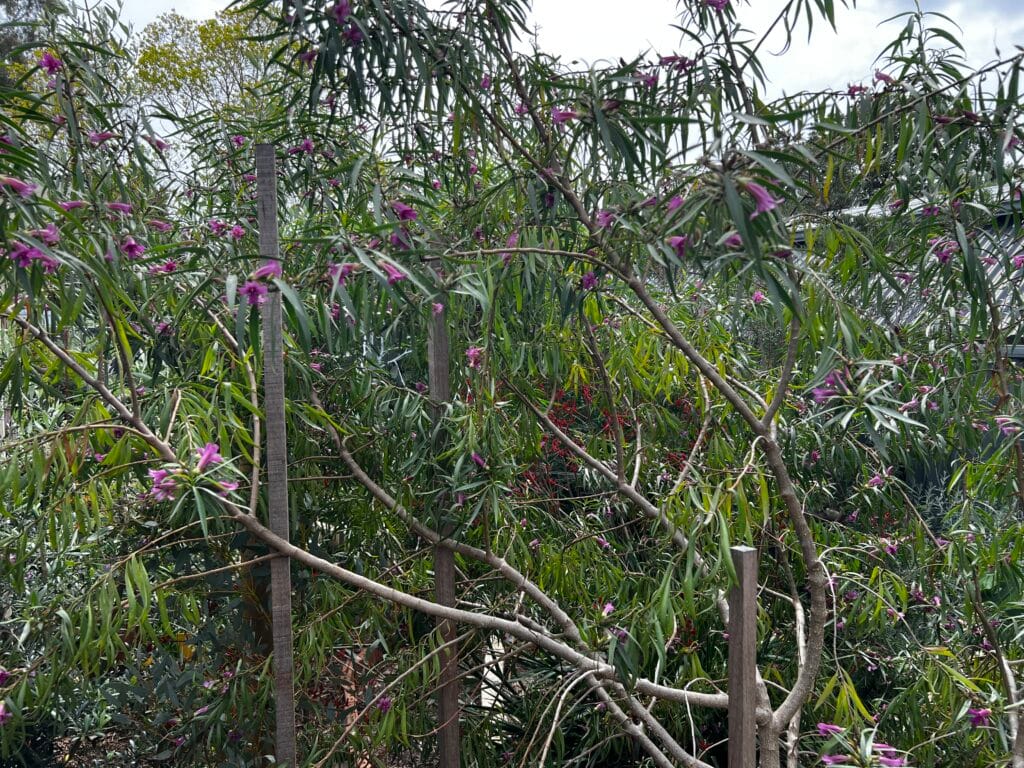
Listening to the diverse sounds around me, I spot two small wagtails darting in and out of a 3.5m tall yellow flowering Acacia Xanthina, a white-stemmed wattle tree endemic to Western Australia. Not far away to the right, I see two bees presumably drinking nectar, gathering pollen, and in turn pollinating plants as they move from flower to flower on a dense, 3m tall, violet flowering Eremophila viscida native shrub. I’m smiling both at the beauty and how good it feels. Things definitely appear to be heading in the right direction, at least in this little ecosystem that I call my garden.
I’m very fortunate to be able to consider this my thinking space, my outside office if you like. Not just for reading and writing, but simply put, its a space where I can connect with nature and just ‘Be’.
Admittedly, there are other opportunities nearby to connect with nature, including some small parks set aside for recreation. In addition, there’s the beautiful Kings Park Botanic Garden located high above the city centre of Perth, where some of the great diversity of West Australian flora can be enjoyed. Aside from these, to exit the built environment and find nature in a more natural setting, I would need to drive some 50km or so from the Port town of Fremantle to the area that we refer to locally as ‘The Hills’.
In fact, elsewhere in this blog you can see examples of ‘The Hills’ in the images of The John Forest National Park, a beautiful expanse of native vegetation rich in indigenous history.
We have become disconnected from nature
As the environments in which many of us live become more and more populated and building-dense, and where the dominant sounds are traffic and construction tools, a tragedy of this so-called ‘progress’ is that we have either already lost, or are losing ‘sense’ of what it means to connect to nature, and by implication, enabling nature to nurture us.
I carefully choose to use the word ‘sense’ here, to emphasise that we connect with nature not just with our sight, but rather, with all of our sensory capacities and beyond. Yes, we have become disconnected from nature, and by implication, from our wellbeing. More on this below. In fact, ironically even, we go to great lengths in many of the environments in which we live to prevent nature from encroaching on our lives. We consider ourselves the masters of nature. We cut her back, we chop her down, we spray her with chemicals, and where we allow nature to touch the edges of our lived environments, we either put a fence around her or build a wall to keep her out.
Nature and wellbeing
I’m sure most of you reading this post will be familiar with the physical, mental and cognitive wellbeing benefits of time spent in and connecting with nature. Among others, time spent in nature improves our mood, reduces stress, anxiety and depression, aids heart health by lowering physical tension, and of course engaging in physical activity in nature improves our fitness levels. Indeed, there is a rich body of empirical evidence supporting the positive human-nature relationship. Rather than discuss the evidence in detail here, I have included some relevant links for you in the reference section below.
So, whether it is a place for play or rest, or simply a space to be to ground yourself, to connect directly with nature by walking barefoot through a forest or garden, or even a place to disengage from the complexities of life in a busy city, the benefits of time spent in nature, of communing with nature are clear. Sadly however, in many parts of the world, as a result of our desire to exert control over nature and our wider environment, these experiences are fast becoming cherished nostalgic memories.
Residential jungles
I don’t have to drive far south of where I live to experience vast concrete new-build residential jungles, mono-design houses spaced so close together that one can easily imagine being able to walk from roof top to roof top. Often these spaces are void of vegetation, and trees if left en situ during groundworks look oddly placed and often stand alone, their root systems disconnected from the life giving root systems of other trees spaced some distance away.
Strangely, what can frequently be seen in these built environments, are newly laid plastic lawns, each unwittingly capable of reflecting the searing heat back into adjacent houses, and whose owners go to war with their air conditioners as their weapon of choice against the generated heat, and of course the rising energy bills.
The drain on the local grid during the summer months as people return home from work and automatically switch on their aircons (popular vernacular), can frequently lead to widespread power outages due to overload.
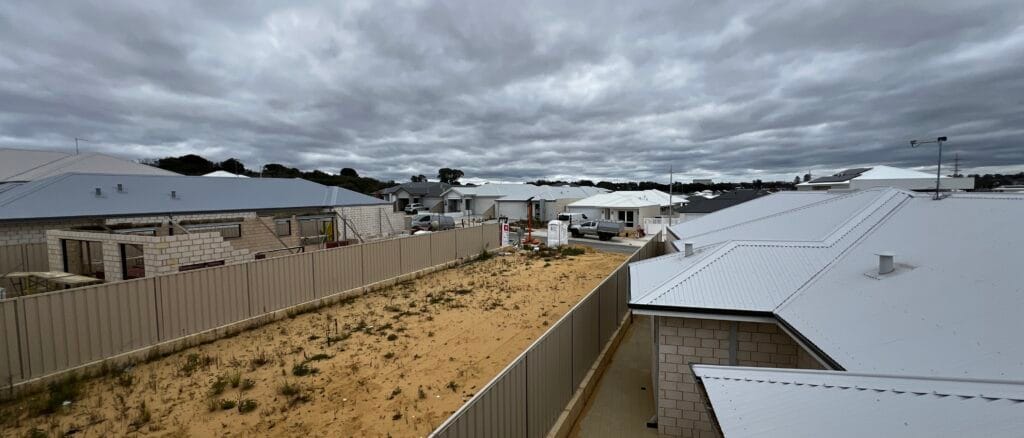
I’m purposefully using provocative prose here in an attempt to conjure up an image for you which no doubt, at least for my fellow Australians anyway, will be all too familiar.
We know that this and other similar ‘living condition’ examples aren’t sustainable, let alone regenerative, and yet, still, perhaps daily, kilometre after kilometre of what was once rich carbon-sequestering forest, is laid to waste to create space for ever more vastly oversized non-passively designed properties.
Each perhaps with a dedicated theatre and games room. Locations to gather to pass the time indoors. A place to escape the baron concrete jungle on the other side. Sadly too, a place that guarantees disconnection from neighbours and from nature. Our source of community, life and wellbeing.
Connecting with Nature
Some of you may think that I’m being overly dramatic with the above prose. Dramatic, yes, perhaps. But, it is also sadly reflective of the truth. Isn’t it? A truth that we have created and continue to support both directly and indirectly by our demonstrated priorities and behaviours. If anything, the real picture is arguably worse than the one that I have painted above.
I drive south in the SW of Western Australia, and I could weep at some of the housing developments that have burst on to the scene in recent years. Developments – and it seems ironic to use the word ‘developments’ here in this respect – but anyway, developments that have desecrated some of the most beautiful country that I have encountered anywhere in the world. And all of this in the name of socio-political and economic progress. Or is it perhaps even more complicated than that? Is it about a misdirected human need to exercise power over nature as I alluded to earlier. Or is it because we seem to need to present external tangible signs of our personal success? Yes, I could keep going here, but I’ll refrain myself – for now! Clearly, the reasons are multifarious.
I know………….its complicated isn’t it. I can see some of you nodding, acknowledging that the same is true where you live, whether it be here in Australia, New Zealand, The United Kingdom, Canada, Switzerland or elsewhere in the world.
What do we need to do about this?
Co-creating a new reality
We need to co-create a new reality. To find our way back into nature. More accurately, we need to find a way to support nature back into our lives, into the spaces that we inhabit. And when we consider creating new living spaces, we need to do so recognising our innate need to live alongside and in community with nature – not separate and distant from nature. In fact, if we could see ourselves accurately as a part of nature, we would surely cease to practice destructive separating behaviours.
Designing in collaboration with nature
Similarly, the buildings that we call home, and where they are situated, need to be designed, constructed and located in collaboration with nature and not in place of nature. These considerations should be logical and second nature to us – perhaps even first nature! Moreover, they should reflect the required parameters of town and city planners, as well as building and landscape architects.
Regenerative town and city planning, regenerative building and landscape architecture should be the norm and not the exception. They should be encouraged, acknowledged and rewarded with approval not rejection. After-all, it is not the regenerative practices that are unusual, rather that honour surely belongs to those practices that negatively impact on human wellbeing!
Here’s your question for reflection then………….So, why aren’t these regenerative practices the norm?
Where and how we live, should be informed by nature, and the requirements of planetary health.
Recall my suggested statement of purpose from a prior post………:
“Can there be a more valuable purpose in life than to live in service to planetary health?”
Where and how we choose to live represents a part of what it means to ‘live in service to planetary health’. It needs our utmost urgent attention. We are heading the wrong way. In fact, we passed the ’Turn Back’ sign a long time ago!
Future posts
In the forthcoming posts I will explore in greater detail key aspects of regenerative design as it pertains to the living domain. The design of the spaces in which we live, commune, work and play, and ultimately, that enable us to maintain behaviours that are in every sense….in service to planetary health. I hope that you’ll join me.
References
Nature connection and wellbeing
National Survey Australia 2025
World Health Organisation: Improving health and wellbeing through nature