Introduction
I imagine you had to read that title at least twice! Is that even possible I hear you asking yourselves. After all, to consume is generally thought of as being a degenerative action. What do we consume? We consume finite resources, whether as goods and services or otherwise. Therefore, the argument would run that consumption as a process and action is degenerative.
Is regenerative degeneration possible?
Over the 30+ years that I taught sustainable marketing at a top Australian university, I frequently asked myself a similar question i.e. can marketing really be sustainable? Most people with whom I came in to contact considered the two words, when combined, to be an oxymoron. These same people would surely therefore consider ‘regenerative consumption’ to be an even more solid oxymoron!
Dissecting the oxymoron
I wish to dissect the words further to explore whether ‘oxymoron’ is too strong a label, and maybe even potentially inaccurate!
First, let’s remind ourselves what regeneration is in simple terms. Paraphrasing from an earlier post, I define regeneration as….. a self-driven – inherently originating – process of enhancement, ultimately leading to a positive state of wellbeing for an identified agent, unit or entity. This positive state of well-being is often described with the words ‘thriving’ and ‘flourishing’.
Connecting regeneration with thriving and flourishing
We can visualise this more clearly by imagining a forest that is able to do what it does best, regenerate itself, and exist as a healthy thriving forest. This doesn’t mean that the forest isn’t experiencing some challenges, but importantly, it is able to overcome these challenges, whatever they are, and thrive in doing so. Under optimal conditions, with an absence of challenges, we might describe that forest to be flourishing. Can you think of such a forest, one that you would describe as thriving and/or flourishing? I imagine that you can. Perhaps you’ve also used the words ‘thriving’ and ‘flourishing’ in relation to something else before in your life. Perhaps yourself, someone you know, a relationship, your garden, a football team and maybe even your community.
Consumption
Now let’s turn to the verb ‘to consume’. As identified, consumption is generally negatively associated with a degenerative process that in simple economic marketplace terms, includes a producer and a final consumer. The process, more complex than we need to go into here, can be simplified in the following way. First, let’s recognise consumption as an process involving some form of consumption by all parties involved. Simplistically, it involves converting and/or breaking down finite resources into goods and services by both organisations and individual consumers. There are organisations that extract the finite resources from source, organisations that turn those resources into something, organisations involved in their transportation and distribution, organisations that sell them, and then there are the end consumers who pay for them. All are involved in an aspect of consumption. I should point out that this example relates more specifically to tangible goods products.
Service products are admittedly a little different in that production and consumption essentially occur at the same time. Some refer to this as prosumption (production-consumption). Here, the consumer is a prosumer, because they assist the service provider produce the experience. In other words, together they co-create the service offering. Let me not digress too far. The main point to note is that multiple parties, whether for goods or service products, are involved in the process of consumption.
Closing the loop and the circular economy
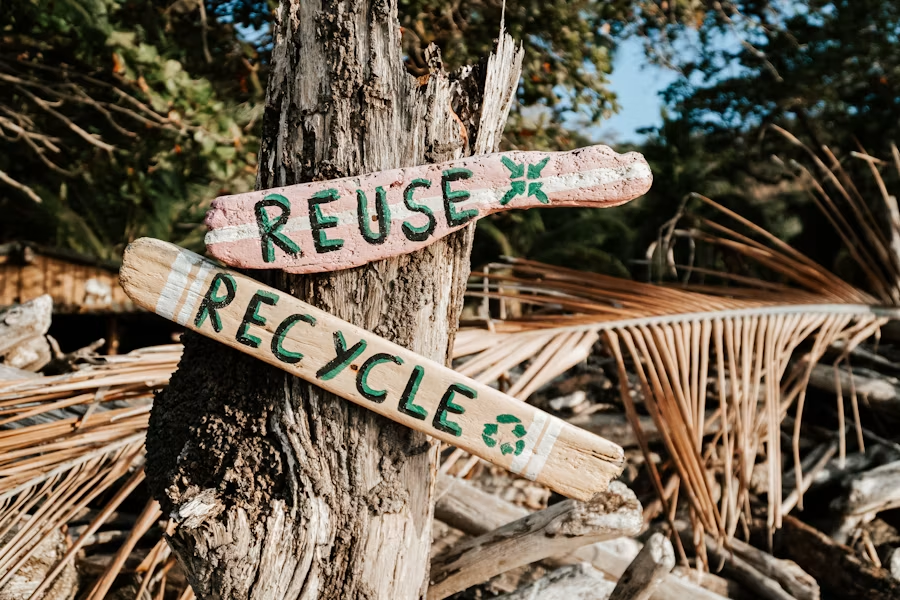
As individual ‘end’ consumers, we know that goods and services have a limited life expectancy. Yes, many can have their useful life extended by exposing them to some form of waste management strategy i.e., recycling, upcycling, down-cycling etc. Indeed, this is the point behind concepts such as ‘creative reuse’, ‘closing the loop’, and ‘the circular economy’ which you might have read about elsewhere. However, not even these are fully regenerative. At some point a gap appears, and goods and services exit the loop per se, whether open or closed, to join other goods and services in an ongoing process of degeneration.
Cynically therefore, no matter how positive, a closed loop is like a holding bay for goods and services whose future is inevitable decline.
So, although we’ve learned a bit more, we seem to be no further forward in being able to positively align consumption with regeneration. For assistance I’ll turn to nature. Let’s start with an easy example.
Nature regeneration
Without complicating the matter with location specifics, imagine a fire raging through an area of dense bush (vegetation) decimating everything in its path. Within a short space of time, and this is important, without the need for human intervention, a once decimated bush area can begin to regenerate. Indeed, in Australia, where I live, many native plants rely on fire to stimulate what is referred to as epicormic seed sprouting, which promotes more rapid, stronger plant growth and resilience.
To summarise, while they can initially consume everything in their path, and are in that sense degenerative, fires also carry with them on their path of destruction, the potential for regeneration. Indeed, from degeneration, regeneration arises. Perhaps it is even a necessary precursor!
What I have done thus far, and maintaining a botanical analogy, is plant a seed, an idea, where the seed of an idea runs that the concept of regenerative consumption is perhaps not such a strong oxymoron after all!
Future post: Part two
In Part two of this post, I’ll pick up and elaborate further on this point. Doing so, will take us closer to the point where we can recognise, conceptually at least, that regenerative consumption is not such an oxymoron after-all.